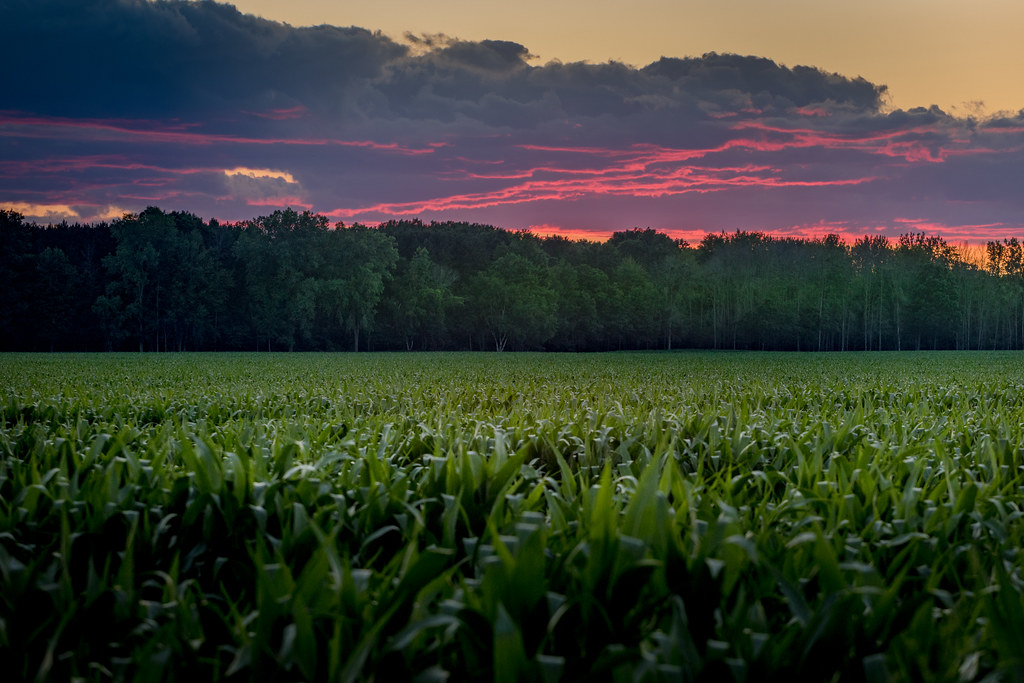
The two rows of dent corn on Greta Solberg's farm outside Newfane, Vermont, stand about a hundred and forty feet from the southern property line. Across that line, in a fifteen-acre field belonging to her neighbour Roy Brookman, are roughly twelve thousand plants of a commercial sweet corn variety that has been the family business since 1978.
Solberg's two rows are a Vermont-selected dent corn called Tobin's Bloody Butcher, which she has been saving and improving since 2017. Brookman's twelve thousand plants are pollen abundant, and the prevailing summer wind in the valley runs from south-southwest to north-northeast, which is to say directly from his field to hers.
Corn is wind-pollinated. The recommended isolation distance for saving genetically pure open-pollinated corn seed is one mile from any other corn variety. Solberg has roughly one-twelfth of that distance, in the wrong direction.
She saves seed anyway. The methods she has developed over nine years are not in any textbook Sage Marchetti has been able to find, though Marchetti suspects they are not unique to Solberg. They are the kind of practical knowledge that small farmers in tight quarters work out for themselves.
The Solberg farm is twenty-three acres of mixed vegetable, small-grain, and livestock production. Greta Solberg, who is forty-one, took over from her father in 2014 after fifteen years working at a seed company in California. She came home with strong opinions about regional seed adaptation and a determination to save her own.
The Tobin's Bloody Butcher line came to her in 2017 from an elderly farmer in Townshend named Earl Tobin, who had selected it from a Bloody Butcher accession he had grown since 1962. His selection had pushed the variety toward earlier maturity and shorter stalks suited to the cool Vermont valleys. When he stopped growing it in 2017 he gave Solberg three pounds of seed and asked her to keep it going.
The first year she planted a quarter-acre block in the most isolated part of her farm, which was still less than half a mile from Brookman's sweet corn. The seed she saved from that block, planted out in 2018 to evaluate, showed obvious crosses. Roughly fifteen percent of the kernels were yellow-and-white striped, classic sweet corn introgression, rather than the deep maroon of the parent line.
She had three options. Abandon the variety, find different land, or develop a method that worked on her land.
The method she developed, and has refined since, uses time isolation rather than distance isolation. Field corn and most sweet corns shed pollen for a relatively narrow window, perhaps eight to ten days, in mid-July to early August in southern Vermont. If she can time her corn to shed pollen outside that window, the crosses drop dramatically.
Brookman plants his sweet corn in three successions, the first usually around May 5 and the last around June 15. The successions reach pollen shed about seventy days later, which means his field is shedding pollen from roughly mid-July to mid-September. There is no time window in the Vermont growing season when Brookman's field is not shedding pollen.
Solberg's response was to hand-pollinate the seed crop. She does not hand-pollinate every ear. She hand-pollinates enough to maintain the line, perhaps thirty ears per season, which is sufficient seed for the next year's planting and a small surplus for the seed exchanges.
The hand-pollination protocol is straightforward but laborious. Before the silks emerge on a given ear, she covers the ear with a small paper bag tied at the base. Before the tassels on the same plant begin shedding pollen, she covers the tassel with a larger paper bag.
Each morning during the pollen-shed window she walks her two rows, opens the tassel bag on a chosen plant, taps the pollen into the bag, then carries the bag to a different plant whose ear bag she has just opened. She dusts the silks with the pollen, replaces the ear bag, and ties a coloured wire around the stalk.
She crosses ear-by-ear from one plant to another within her rows, never from one plant to itself, which maintains genetic diversity. Over the course of the pollen-shed window, which in her two rows lasts about a week, she completes the thirty pollinations.
The bags stay on until the silks have fully browned and there is no risk of additional pollen reaching the ear. Usually about ten days. Then the bags come off and the ears mature normally.
At harvest in late September she pulls the thirty bagged ears separately from the rest of the crop. The bagged ears are her seed crop. The remaining ears, which have been open-pollinated and therefore include genetic contributions from Brookman's field, become cornmeal for her own kitchen and for sale at the Newfane farmstand.
She husks the seed ears, evaluates each one, and selects the ten or twelve best for seed. The selection criteria are her own: deep maroon kernel colour, full kernel set to the tip, straight rows, and a cob that is sound and not unusually pithy. The other twenty go to cornmeal.
The selected ears dry on a rack in her seed barn for six weeks. She shells them by hand in early November, discarding the small kernels from the tip and the base of each ear and keeping only the uniform kernels from the middle two-thirds. The selected seed goes into labelled glass jars and lives in her root cellar until April.
Marchetti has grown out Tobin's Bloody Butcher from Solberg's 2024 seed in her own garden in Northampton. The off-type rate was under one percent, which is well within the range expected from a long-isolated line.
The method is laborious. Solberg estimates she spends about forty hours over the course of a season on the seed crop, separate from the time spent on the meal crop. The yield in saved seed is small, perhaps five pounds, which is enough for her own farm and for the half-dozen other Vermont growers she sends seed to each winter.
She has considered moving the corn to her uncle's hayfield in Westminster, which is genuinely a mile from any other corn, but the logistics of fencing, watering, and walking the seed crop daily during pollination defeat the proposal. The hand-pollinated rows at home, despite Brookman's field, have proved more workable.
Tobin's Bloody Butcher is now grown by twelve households in southern Vermont, all originating from Solberg's increases. Earl Tobin died in 2022. The line continues, in a form he would recognize, on land he never owned, kept by a method he never used. Which is how seed has always travelled.
Filed under