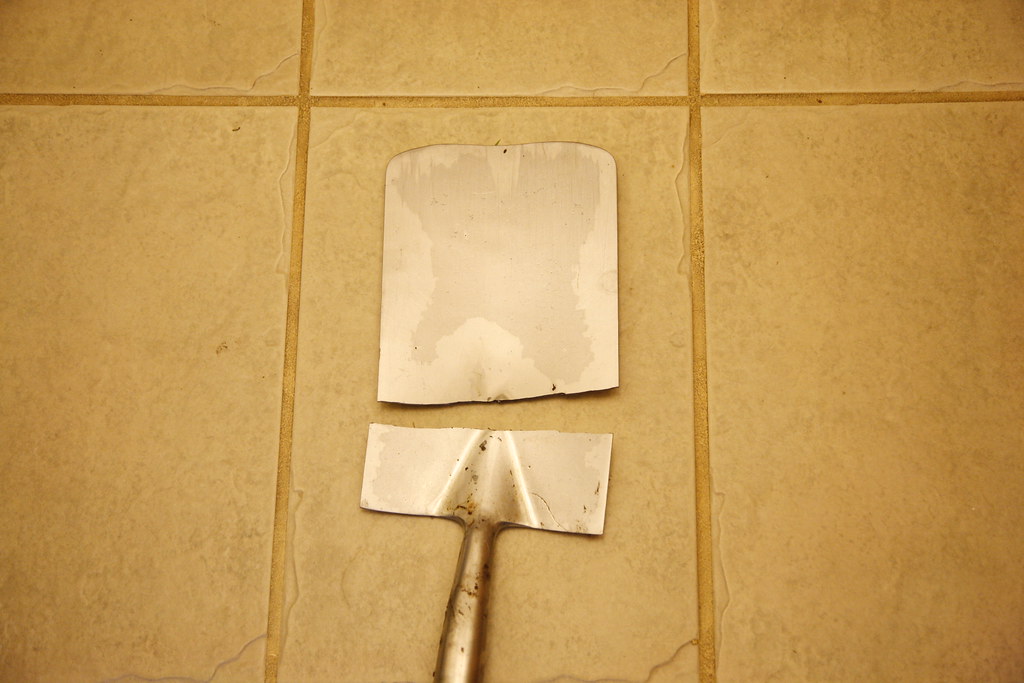
Eloise Vinter keeps a flat hand-scraper made from an old chisel blade in a tin nailed to a beam in her tool shed. The chisel was given to her by a joiner in Wymondham who was clearing out his father's workshop in 2018. She ground it flat on a coarse stone, hung it from a hook, and has used it almost every day she has lifted a spade since.
The ritual is simple. After a session of digging she walks the spade back to the shed, props it head-down against the bench, and runs the scraper along both faces of the blade and along the back. Soil falls in dry crumbs on the floor. She sweeps the crumbs into a corner once a fortnight and tips them into a pot.
If the soil was wet she dries the blade with a rag from a bucket of rags kept for the purpose. The rags are cut from old shirts, washed monthly, and rotated back into the bucket. She has not bought a paper towel for the shed since 2014.
If the blade is dry she rubs it with a small pad of oily wool kept in a jam jar with a screw lid. The wool is from a fleece a friend gave her from a Devon Closewool ewe, lanolin-rich and oddly self-replenishing. A pinch of motor oil refreshes it twice a year. The blade comes out of the jar dark and faintly slick.
The spade goes back on its hook, blade-up, against the south wall of the shed. The handle is oiled with raw linseed in February and otherwise left to weather. The whole sequence takes ninety seconds. She has done it perhaps four thousand times.
There are gardeners who do not do this. They lean the spade against the compost heap on Sunday afternoon and pick it up next on a wet Friday in November, when the blade is orange with rust and the soil from the last job is a baked grey crust along the shoulders. Vinter does not judge them. She used to be one of them. She judges her own past self mildly, the way one might judge a younger sister who has since reformed.
The case for cleaning a spade is mostly practical. A clean spade cuts more easily into compacted soil. A clean spade weighs less in the hand at the end of a long day. A clean spade does not transfer the fungal spores of one bed into the soil of another, which matters in any garden where the borders include roses, brassicas, and tomatoes in the same season.
There is also a soil-hygiene case that is not as well known as it should be. The mycelium of Verticillium dahliae, the soil fungus responsible for wilt in tomatoes, dahlias, and a long list of ornamental shrubs, can persist on a spade blade for weeks. A gardener who digs in an infected bed and then, without scraping, digs in a clean one has performed an act of unintentional disease transmission.
The scraper is the simplest tool against this. Vinter has read papers from Wageningen and East Malling on the survival of verticillium and clubroot spores on garden hand tools, and the conclusions are unsurprising: clean tools transmit less disease than dirty tools, and clean dry tools transmit less than clean wet tools.
What is harder to write about, because it sounds precious, is what the ritual does to the gardener.
Vinter has come to think that a clean spade is the visible form of a habit of attention. The minute spent at the bench after digging is a minute spent not yet moving on to the next job. The hand on the scraper, the soil falling away from the blade, the small bright crescent of edge re-emerging from the day's work — these are not, exactly, mindfulness exercises. They are too unselfconscious for that. But they have the same effect.
She has noticed that on days when she skips the cleaning, perhaps because she is hurrying inside before a rain shower or because the telephone is ringing, the next day's first hour in the garden begins less settled. The skipped ritual leaves a small residue of disorder, which then has to be paid back, usually with interest.
The sharpening question is separate from the cleaning one. A spade does not need to be sharp the way a knife needs to be sharp. It needs to be sharp enough to slice through a fibrous root of couch grass on a downward swing, and no sharper. A field edge of about 30 degrees, kept up with a few strokes of a coarse file once a month, is enough.
Vinter uses a 250mm flat bastard file from the same Sheffield manufacturer who made the file her grandfather used. She runs it along the bevel four times on each face, pressing into the cut on the forward stroke and lifting on the return. She does this on the first of the month, more or less, from March through November.
She does not sharpen in winter. The spade rests in winter the way the gardener does, on a hook, oiled, expecting nothing.
There is a spade in her shed that she inherited from a woman named Margery Vinter, no relation, who had gardened a small plot at the edge of a village outside Cromer from 1953 until her death in 2014. The blade is forged steel, the handle T-bar ash, the socket riveted rather than welded. Eloise has used it perhaps three hundred times. It still cuts as well as the new Sneeboer spade she bought in 2022.
She does not believe in tool-fetishism. She has seen too many sheds in which beautiful hand-forged spades hang on the wall like art objects, untouched, while the actual digging is done with a cheap stamped spade from a garden centre. The tool, for her, is the act of using it.
But she also believes that a tool maintained by hand, day after day, becomes a kind of record of the garden it has worked. Margery's spade has a slight bow in the blade from forty years of leaning into the same clay. Eloise's Sneeboer has not yet developed any such mark, and may not in her lifetime.
She has begun, lately, to think that the small flat scraper from the joiner in Wymondham will outlast her. She has begun to think about who will use it next. The thought is not morbid. It is the kind of thought that the work of cleaning a spade tends to produce, after a few thousand repetitions.
If she had one piece of advice for a beginning gardener it would not be about technique or design or even about which spade to buy. It would be this. Find a flat scraper somewhere, hang it near the shed door, and use it every time the spade comes off the bed. After a year, see what has changed.
She suspects, but cannot prove, that it will not be the spade.
Filed under