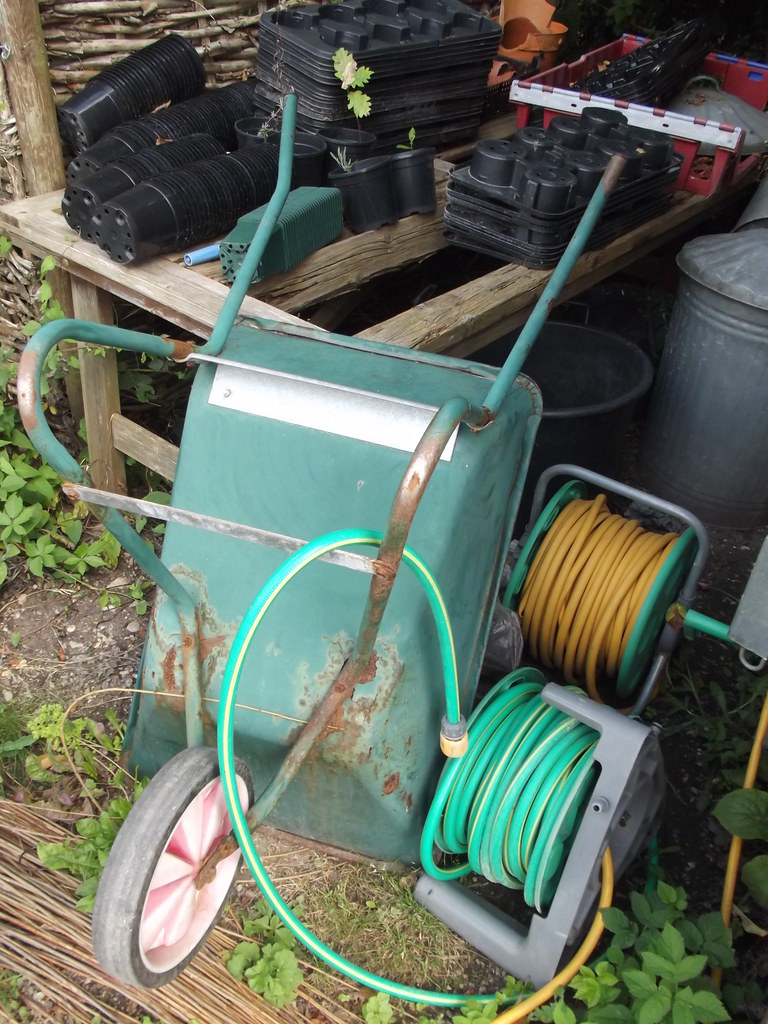
On the eleventh of March 2026, Eloise Vinter wheeled a green Chillington Plantation wheelbarrow for the last time, from the bottom of her vegetable plot to the gate at the back of her Norfolk garden, set it down beside the compost heap, and photographed it. The barrow had carried, by her best estimate, 318 tonnes of material since its first use on the twelfth of April 2016.
She had bought it from a small implement supplier in Diss for £148.50, after a conversation with the proprietor in which she explained that she wanted a barrow that would still be working in 2026. The proprietor, a man named Roy Wakeling who had been selling barrows for thirty-one years, recommended the Plantation. He said it would do the job. He said nothing more.
The Plantation is a heavy-duty steel barrow with a pressed-steel body, tubular steel frame, and a single 16-inch pneumatic wheel. The body holds 85 litres, struck level. It weighs, empty, 19 kilograms. It is made in a factory in Witnesham, Suffolk, by a company that has been forging garden tools in one form or another since 1832.
Vinter began her notes on the second day of use. She wrote in a small green notebook that lives in a drawer in the shed. She did not intend at the time to keep notes for ten years. She thought she might keep them for a season, and then perhaps for a year, and then it became simply a habit she could not be bothered to stop.
By the end of the first year, on the twelfth of April 2017, the barrow had carried 22 tonnes of material. She knew this because she had weighed the average load on a luggage scale, found it to be 38 kilograms, and counted the loads. Most years she counted the loads. On the years when she did not she estimated from the previous year's count, adjusted for the work she remembered doing.
The first repair came in May 2018. The inner tube on the pneumatic tyre developed a slow leak, which Vinter ignored for three weeks before replacing it. The new tube cost £4.20 from a bicycle shop in Norwich. She fitted it in twenty minutes, sitting on an upturned crate in the shed, with the radio on.
The second repair came in August 2020. The wooden handles, which were the original beech, had begun to splinter at the front grip from a combination of weather and a small infestation of furniture beetle she had failed to notice in time. She replaced both handles with new ash handles from a tool supplier in Stowmarket, drilling out the original retaining pins with a hand brace because the cordless drill was flat and she could not be bothered to charge it.
The third repair, in October 2022, was a new wheel. The original 16-inch pneumatic had developed a slow sidewall split that no patch would hold. She replaced it with a solid puncture-proof wheel of the same diameter, against her better instincts. She does not, in retrospect, regret the choice. The solid wheel rolls slightly heavier on level ground but never goes flat in the middle of a job.
There were no other repairs in ten years. The body developed surface rust along the upper rim from 2019 onwards, which she wire-brushed and painted twice with a small tin of Hammerite Smooth Green in 2021 and again in 2024. The frame she has never painted. It has acquired the patina of a barrow that has been used.
The tonnage accumulated steadily. In 2018, a year in which she rebuilt a long bed along the south wall, the barrow carried 41 tonnes. In 2021, a year in which she was recovering from a frozen shoulder and worked the garden less, it carried 19 tonnes. In 2024, the year she had three lorry-loads of mushroom compost delivered to the gate, it carried 47 tonnes, which is more than she would have believed possible if she had not been counting at the time.
She wheeled compost, leaf mold, mushroom compost, well-rotted horse manure, grit, sand, soil-improver, gravel, pea-shingle, chipped bark, crushed brick from a demolished outhouse on a neighbour's plot, hedge clippings, brassica stalks, a Christmas tree in January 2019, a sick lamb in March 2020, a barrow-load of windfall apples she meant to take to the chickens and forgot for three days, a pile of slates from a re-roofing job in May 2022, and on one memorable Saturday afternoon, her seven-year-old great-niece Beatrix, who weighed almost exactly the recommended maximum load and laughed the entire length of the path.
The handles, after their 2020 replacement, are now the original ash, weather-darkened to nearly black at the grip and honey-pale where the hand has held them. Vinter would not exchange them for new ones. They fit her hand the way a kitchen knife fits a cook's hand after a decade.
What surprised her, over the course of the ten years, was how often the barrow itself was the limiting factor in a job and how rarely. Almost every other tool in her shed has been replaced at least once. The cordless drill is now its third iteration. The hosepipe is its fourth. The kneeling pad has been replaced annually, having a structural lifespan she once estimated at about thirteen months. The barrow simply went on.
There is, she would now say, a strong case for buying one good barrow and keeping it. The Plantation cost her £148.50 in 2016. A comparable steel barrow today costs about £210. Distributed across ten years and 318 tonnes, the cost-per-tonne of the barrow's working life comes to approximately 47 pence. By any sensible accounting this is a bargain.
She has known gardeners who buy a barrow from a supermarket for £39 every two or three years, and who at the end of a decade have spent more than she did and have less to show for it. She has known one gardener who bought a hand-forged ash-handled barrow from a wheelwright in Sussex for £680 and uses it perhaps once a week.
The retirement was not dramatic. The body had begun, in the winter of 2025, to show metal fatigue around the bolt holes where the body meets the chassis. Vinter could see daylight along one of the seams. She had welded it once, in 2023, and was unwilling to weld it twice.
She did not throw it out. She moved it, on the eleventh of March 2026, into the corner of the orchard, where it now holds a 70-litre pot of a young medlar tree she planted on the same afternoon. The body is the planter. The frame holds the body off the ground. The handles, oiled one final time with linseed, point south towards the garden it served.
She has not yet bought its replacement. She is considering another Plantation, from the same supplier, who is now Roy Wakeling's son Edmund. She is also considering a Haemmerlin Twinwheel, which has a wider body and a second wheel for stability on slopes.
Whichever she chooses, she has decided, will be the last barrow she buys. She is sixty-three. A barrow bought now should outlast her active gardening years. She finds this thought less melancholy than she expected.
The first Chillington still stands in the orchard, holding the medlar. The medlar will, in time, outgrow the barrow. The barrow will rust through. The handles will rot. The whole assembly will, in twenty or thirty years, become indistinguishable from the soil it spent its working life moving.
Vinter thinks this is, on the whole, a satisfactory ending for a wheelbarrow.