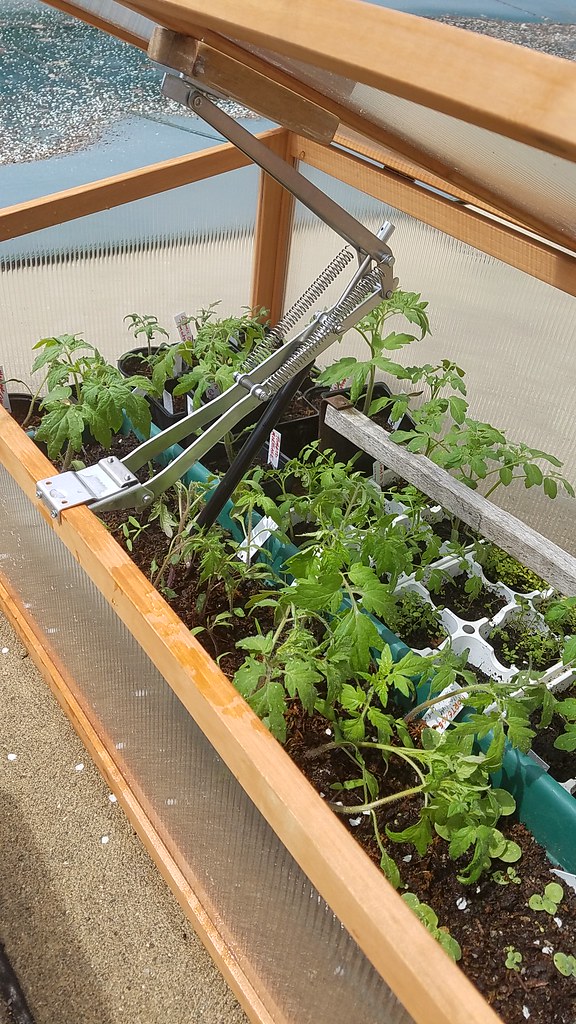
On the morning of February 3rd, in a kitchen garden outside Greenfield, Massachusetts, the cold frame at the south wall read 11 degrees Fahrenheit on the air thermometer and 28 inside the box. The snow against the back panel had drifted to eight inches. The glass was clear.
The frame belongs to a teacher named Helen Maddox, who built it in 2017 from a salvaged storm window and four cedar boards. It measures four feet by six. It sits on the south side of a stone retaining wall that holds heat from the previous afternoon, and it has, by Helen's account, never once been empty since she finished it.
Wintergreen visited the frame eleven times between February 3rd and March 17th. The notes here are taken from those visits and from the temperature log Helen keeps on a clipboard nailed to the inside of the lid.
The thing to understand about a cold frame in zone 5 in February is that it is not heated. It is, in the technical sense, a passive solar appliance. It captures whatever sunlight falls on it during the day, traps it under glass, and releases it slowly through the night against insulated walls.
On a sunny February day the interior can climb to 75 degrees by two in the afternoon. By six the next morning, after a clear cold night, the same frame will read 18. The plants inside have to tolerate a 57-degree daily swing. Most plants cannot. A small number of them can.
Helen's February frame holds mache, claytonia, spinach Bloomsdale Long Standing, and a flat of overwintered parsley sown the previous August. The mache and claytonia are harvestable now in small cuttings. The spinach is dormant but green. The parsley is bronzed at the leaf tip and otherwise fine.
There is also, in one corner, a black plastic flat sown on January 22nd with onion seed. The onions germinated on February 9th, in soil that on three nights had frozen to a depth of half an inch. They came up anyway.
Helen's method for the onions is one she learned from a Vermont seed-saver named Marian Foss. The seed goes into a soil block kept moist under a sheet of glass inside the frame. The frame stays closed unless the daytime air rises above 45. The block freezes most nights. The seeds do not seem to mind.
The cold frame's lid is hinged at the back. Helen props it open with a notched stick in three positions: half an inch, three inches, and full. The half-inch prop is for any day above 35. The three-inch is for anything above 50. The full prop, in February, is almost never used.
The principle is that a closed cold frame on a sunny February day will cook its contents. Lettuce will wilt at 90 degrees and recover. Spinach will bolt if held above 80 for two consecutive afternoons. The propping stick is the gardener's sole input.
On February 14th the frame ran to 81 degrees while Helen was at work. She had left the prop at half an inch in the morning, expecting cloud. The afternoon cleared. The mache, on her return, was limp at the outer leaves. By morning it had recovered. She did not lose the planting.
This is the central admission of the cold-frame method in February. The gardener will miscalculate. The plants will mostly forgive her. The cost of a forgotten prop on a sunny day is, in February, one row of greens.
Helen's log lists, between February 3rd and March 17th, four such incidents. Two cost her nothing. One scorched a flat of lettuce seedlings sown too early. One, on March 11th, burned the growing tips off a flat of Tatsoi she had counted on for April salads.
The losses are real. They are also, set against the gain of six weeks of fresh greens in a New England winter, modest. Helen estimates she harvested around four pounds of mache, claytonia, and spinach from the frame between Christmas and the spring equinox.
Four pounds of winter greens does not sound like much. In February, in zone 5, it is the difference between a salad and no salad. The grocery substitute, trucked from California, would cost roughly forty-five dollars over the same period and would taste, Helen says, like wet paper.
The cold frame's second function, in late February, is as a germination chamber for hardy seedlings the gardener wants to set out in April. Onions, leeks, brassicas, parsley, and certain hardy annual flowers all germinate well in a closed frame between February 20th and March 15th.
Helen sows in soil blocks rather than cells, on the reasoning that a soil block can be transplanted with no root disturbance and that the frame's narrow vertical space holds more blocks than trays. By March 17th her frame held sixty-four blocks of various seedlings, ready for hardening off.
The hardening-off period for cold-frame-raised seedlings is shorter than for indoor-raised. The plants are already adapted to wide temperature swings and to natural light. Helen typically gives them four days of open-frame exposure before planting out, against the standard week to ten days for indoor stock.
There is a smaller frame at the eastern edge of the garden, also Helen's, built three years later from oak. It does not perform as well. The east-facing orientation gives morning sun but loses the afternoon. The interior on a sunny February day reaches only 58 degrees. The mache in it is thinner and slower.
The conclusion, after eleven visits and a winter of log entries, is that a cold frame in February in zone 5 is a real tool, not a hobbyist's gesture. It produces food. It germinates seed. It costs, in materials, under two hundred dollars and in attention, perhaps fifteen minutes a day.
What it does not do is replace the heated greenhouse. The frame cannot start tomatoes. It cannot hold tropical herbs through the winter. It cannot heat itself on a week of overcast cold. Helen's frame, in the third week of February 2025, held at 22 degrees inside for four straight days and lost a flat of lettuce.
The frame is, in the end, a small thing. It is four feet by six. It holds a few flats and a few salads. It freezes on most winter nights and it warms on most winter afternoons. Helen has kept it going for nine years. She intends to keep it going for nine more.