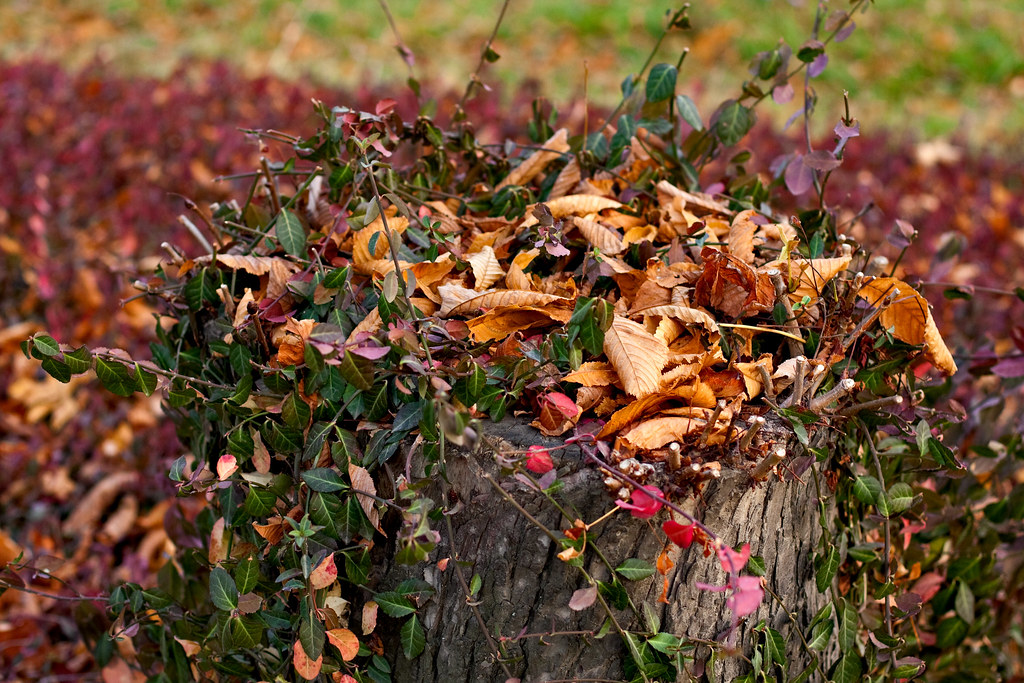
Eloise Vinter's leaf mold bays sit against the north wall of a brick outbuilding in a garden behind the Catton Grove road, in Norwich. There are three of them, built of pallets she had off a furniture maker in 2009, and they each hold roughly fifteen cubic feet of compressed leaves.
She started making leaf mold the autumn she moved into the house. She had read about it in a Christopher Lloyd essay and was struck by the simplicity of the recipe: collect deciduous leaves, pile them up, wait two years.
The waiting was the thing that surprised her. Compost she had made before; that was a matter of weeks or months, with turning and balancing of greens and browns. Leaf mold was a matter of years and required her, mainly, to leave it alone.
She has three bays because she works on a two-year cycle. The bay she filled in November 2024 will be ready in autumn 2026. The bay from November 2023 is ready now. The bay from November 2025 is sitting, mostly intact, waiting for time to do its work.
The leaves come from her own three oaks and a copper beech in the next garden, whose owner, a retired schoolteacher named Phyllis Marsh, has been giving her his autumn sweepings since 2011. Bell gates her own leaves with a rotary mower set high, which chops them and lifts them in the same pass.
She does not turn the bays. She has read the arguments for turning leaf mold to speed it up, but she does not find them persuasive. Leaves break down through fungal action, slowly and patiently, and the structure of the pile is what holds the moisture that the fungi need.
When she lifts the front boards off the two-year-old bay in October, the leaves at the top of the pile are still recognizable as leaves. Below that there is a six-inch layer where the leaf shapes are visible but crumble to the touch. Below that, the leaf mold proper: dark, springy, smelling of the woodland floor at Wheatfen.
She digs the finished material out with a fork, sifts it once through a half-inch mesh she stretches over a wheelbarrow, and stores it in burlap sacks in the dry corner of the shed. A bay yields roughly twelve sacks of finished mold, and twelve sacks is about what she uses in a year.
She uses it three ways. As a seed-starting medium, mixed half-and-half with a fine compost from the kitchen heap. As a mulch around perennials, applied in November and again in March. As an amendment in the vegetable beds, scratched into the top inch each spring before planting.
What leaf mold gives a garden is not, properly speaking, fertility. It is low in nitrogen, low in phosphorus, low in potassium. The nutrient panel from a soil test will not register the addition.
What it gives is structure. The fungal hyphae and the half-broken-down lignin do something to soil that compost does not quite do. Vinter has noticed it most clearly in her clay beds, where a two-year mulch of leaf mold seems to lift the surface texture and hold it open.
She is hesitant, however, to make claims for it that the soil science does not support. She has read enough to know that the mechanisms by which leaf mold improves soil are not fully characterized, and that the gardener's enthusiasm for it sometimes runs ahead of the evidence.
What she will say is that her garden has used leaf mold steadily for sixteen autumns, and that the beds where she applies it most heavily are the beds that drain best, hold moisture longest in summer, and produce the most consistent crops.
She does not weigh her yields. She is not running an experiment. She is a gardener with three bays full of leaves at varying stages of decomposition, and a working hypothesis about what they do.
The hypothesis has held for sixteen years.
Last October she added a fourth bay. Phyllis Marsh, who is now eighty-three, has had to give up the beech tree to a tree surgeon, and the year's sweepings were unusually large. Vinter put the surplus into the new bay and covered it with a sheet of old polythene to keep it damp through the winter.
It will be ready, by her count, in October 2027.
She has noted the date in pencil on the inside of the shed door.