In Annetta Wilkes's Vermont kitchen there is a wall shelf seven feet long that holds nothing but herbs in jars. There are no plastic bags, no labeled containers in the freezer, no resealable pouches of vacuum-sealed parsley. Everything she preserves she preserves at room temperature, and most of it will be edible a year from now.
Wilkes is sixty-eight and has gardened on the same five-acre property outside Marshfield, Vermont, since 1989. She keeps about thirty-five herb varieties through the season and aims to put up enough by mid-October to last her household until the following June.
She does not own a chest freezer. She owns a small upright that is mostly bread.
The case against freezing herbs, as Wilkes explains it, is not that the freezer fails. It is that the freezer succeeds at preserving the wrong thing. Frozen basil retains color but loses texture and most of its aromatic top notes within a month. Frozen parsley emerges limp and waterlogged. Frozen chives are usable but no better than the dried equivalent. The freezer preserves the cellulose and the chlorophyll and discards most of what the gardener actually wanted.
The older methods preserve flavor at the cost of form. Wilkes makes this trade willingly.
Her first and most-used method is the salt cure. She layers fresh herbs with coarse sea salt in small glass jars, alternating thin layers of leaves with thin layers of salt, and packs the jar firmly to exclude air. The salt draws moisture from the leaves over several weeks, dries them in place, and creates a flavored salt that can be used in either form.
Basil, parsley, sage, and rosemary all take well to the salt cure. Wilkes uses Maldon for parsley and basil, where the flake matters at the end, and a less expensive coarse sea salt for the curing layers. A pint jar uses about one cup of salt to two cups of loosely packed leaves. The cured herbs keep for at least a year in a cool dark cupboard. The salt itself becomes a herb-flavored finishing salt that she uses on roast vegetables and on the rim of summer cocktails in February.
The second method is oil. Wilkes makes herb oils from basil, oregano, marjoram, and bay, packing the cleaned dry leaves into glass jars and covering them with cold-pressed olive oil. The jars rest in the cupboard for three to six weeks, are then strained through fine muslin, and the resulting oil is decanted into small bottles. The infused oils keep for about six months at room temperature, longer if refrigerated.
There is one warning Wilkes is careful to repeat. Fresh herbs in oil at room temperature are a botulism risk if the herbs carry moisture. The technique works only with herbs that have been thoroughly dried, either by air-drying for several days or by very low-temperature oven drying. Wilkes dries her oil herbs on screens in the back porch for four to six days before they go into the jar. She does not refrigerate the finished oil, but she does not keep it past March, and she does not give it away to people who might let it sit on a counter for a year.
The third method is vinegar. Tarragon, chive blossoms, lemon balm, and the purple basils all extract beautifully into white wine vinegar. Wilkes packs sterilized bottles with the fresh herb, fills them with vinegar, and lets them rest for three weeks in a cool dark place before straining. The vinegars are at their best between three months and two years old and are her standard salad dressing through the winter.
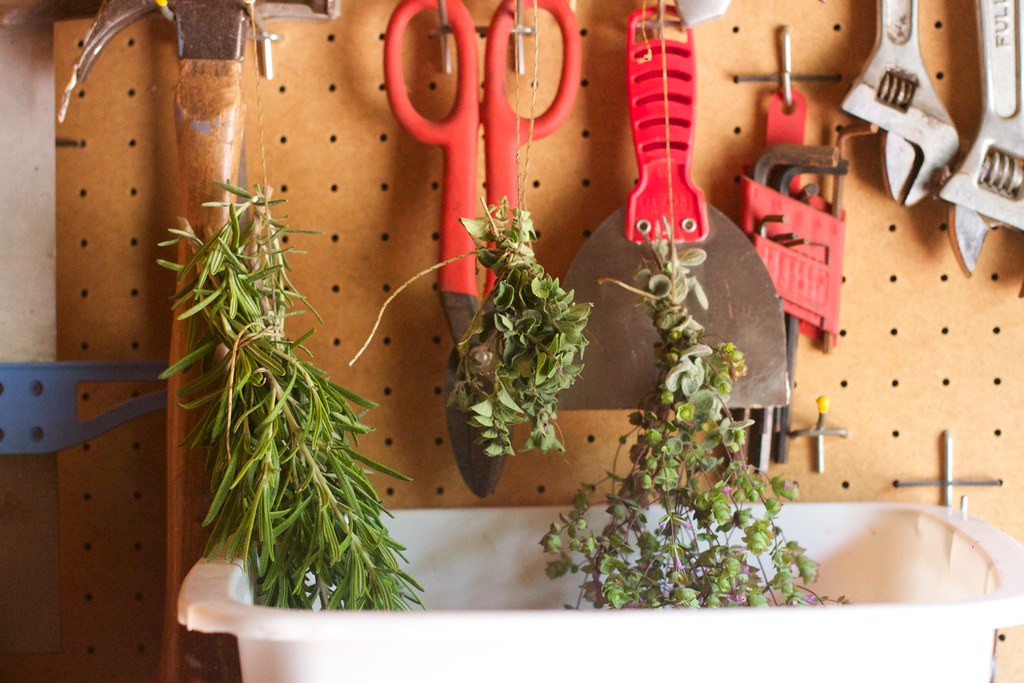
The fourth method, and the oldest, is air-drying. Wilkes hangs bundles of thyme, oregano, rosemary, sage, marjoram, and savory from the wooden ceiling rack in the kitchen. The bundles are small, about an inch in diameter at the stem, and tied with cotton twine. They dry over ten to fourteen days in the dry indoor air of late September and early October. When the leaves crumble between her fingers, she strips them from the stems into glass jars and labels each jar with the variety and the year.
Air-dried herbs lose about thirty percent of their aromatic intensity compared to fresh, but the remaining flavor is concentrated by water loss and stable for at least a year. Wilkes has used air-dried thyme that was three years old without noticeable decline. She has also used air-dried basil from the previous year and admitted it was a disappointment. Some herbs dry well and some do not.
The herbs that do not air-dry well include parsley, chives, chervil, cilantro, and dill. All of them lose almost everything to drying. Wilkes preserves the first three in salt and the last two in vinegar, and she does not attempt to dry them.
There is a fifth method, less common, that Wilkes uses for a small group of herbs: paper. She presses fresh sorrel, lovage, and lemon verbena leaves between sheets of unbleached parchment, stacks them under a heavy book for two weeks, and then stores the dried leaves whole between the parchment sheets in a flat tin. The leaves retain their shape and most of their color, and reconstitute in soup or hot water with surprising freshness. The method comes from a 1940s gardening manual Wilkes inherited from an aunt, and she has not found it in any contemporary source.
Her sixth method is sugar. Lemon verbena, scented geranium, lavender, and rose petals layer into granulated sugar the way basil and parsley layer into salt. The sugar takes on the floral aromatics and is used for shortbread, ice cream bases, and the lemon verbena cake she makes for her sister's birthday every August. The sugars keep for about a year.
What ties the methods together is a refusal to rely on the freezer as the default. Wilkes points out that the freezer is a recent technology, and the long tradition of preserved herbs developed without it. Salt, oil, vinegar, drying, and pressing are the historical methods, and they are historical because they work.
She concedes that the freezer is the right answer for one specific case: pesto. She makes pesto in August from her 'Genovese' basil, freezes it in small jars without the cheese, and uses it through the winter. Pesto is a finished sauce, oil-based, and dense enough that it holds in the freezer better than the leaves alone. She accepts the inconsistency.
The shelf in Wilkes's kitchen is restocked each October and slowly emptied through the year. By June, when the new herbs come in, most of the previous year's jars are empty. The few that are not, she gives away to anyone visiting.
The system has a quiet logic. It assumes the gardener is going to keep gardening, that next year will provide, that the loss of a jar is not catastrophic. It is a system for people who plan to be around in the spring.
Wilkes plans to be around in the spring.