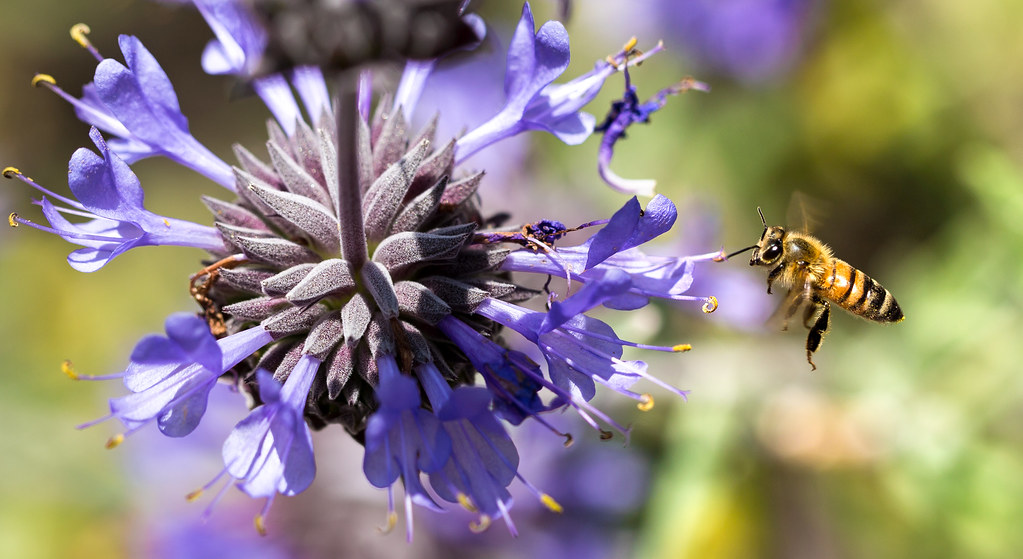
There is a common garden sage in Owen Pellew's allotment in Norwich that he has been on the verge of digging up for three years. It is roughly four feet across, leggy, hollow at the centre, and producing perhaps a third of the leaf it produced in its third year. He has not dug it up because he keeps reading articles that say sage can be renovated.
He has not renovated it because the same articles disagree about how, and when.
The disagreement, on close reading, is mostly about whether the plant is being grown for leaves, for flowers, or for ornament. The advice that makes sense for one purpose contradicts the advice that makes sense for another. Pellew, who grows his sage for cooking, has been reading advice intended for ornamental Mediterranean borders, which is why his plant looks the way it does.
Salvia officinalis is a short-lived woody perennial native to the Mediterranean. In its native climate, on dry rocky slopes with reflected heat from limestone, it lives ten to twelve years and remains compact through annual sheep grazing or wind-pruning. In a cool-temperate English garden, with adequate water and no grazing pressure, it will, left to itself, become a sprawling, hollow-centered shrub within five years and a dead one within seven.
The pruning regime that prevents this is straightforward and almost no English gardening book describes it correctly.
The plant should be cut back twice a year, in spring and immediately after flowering.
The spring cut, in late March or early April depending on the season, removes about a third of the previous year's growth. The cut goes back to a leaf node on green wood, never into bare wood, and the purpose is to encourage a dense flush of new growth from the upper stems before flowering. This is the cut most pruning guides describe.
The post-flowering cut, in late June or early July depending on when the plant has finished blooming, is the cut almost no one makes. It removes the spent flower spikes and another third of the season's new growth, cutting back to the first or second leaf node below the flower stem. The plant responds with a second flush of leaf growth that produces the season's best culinary harvest in August and September.
Without the post-flowering cut, the plant puts its energy into seed production and leaf maturation, the lower leaves yellow and drop, and the plant becomes increasingly leggy. After two or three years without this cut, the centre of the plant is hollow, the productive growth is concentrated at the tips of long bare stems, and the plant looks exactly the way Pellew's plant looks.
The renovation of an already-leggy sage is possible but delicate, and the conventional wisdom that it should be cut hard back into old wood is, in Vinter's experience working with woody herbs across two decades, simply wrong for sage. Old sage wood does not reliably break back. A plant cut hard into bare wood in spring often dies, or breaks back from only one or two points and looks worse than before.
The technique that does work is staged renovation across two seasons.
In year one, in late March, the gardener identifies the strongest stems with active growth and cuts the weaker, more hollow stems back hard into the central rootstock, leaving the productive stems alone. This opens the plant up, restores air circulation, and reduces the load on the rootstock without removing more than about a quarter of the total foliage.
Through year one, the plant is pruned normally: light tip pruning in March on the remaining stems, the post-flowering cut in June, and another light tip prune in early September. New growth from the centre, often from buds at the base of the cut stems, is encouraged.
In year two, in late March, the gardener completes the renovation, cutting back the remaining old leggy stems hard and relying on the new central growth that established in year one to carry the plant through the season.
The result, after two years, is a renewed plant with a dense centre and compact growth. It will not be as vigorous as a young plant, and after another five or six years it will need to be replaced anyway, but it is, for the patient gardener, a way of extending the useful life of an established plant by several seasons.
The alternative, and the one Vinter usually recommends for plants more than seven years old, is replacement from cuttings.
Sage roots easily from semi-ripe cuttings taken in July or August. A four-inch cutting from the current season's growth, with the lower leaves stripped and the cut end dipped in rooting hormone, will root in four to six weeks in a sandy seed compost kept just moist. By the following spring the cutting is a young plant, and within two seasons it is a productive specimen.
A small gardener can replace a tired sage plant with a cutting taken from the same plant in its better years. Vinter takes three to five cuttings every August from each of her sage plants and pots them up as insurance. Most years she gives them away. Occasionally she needs one.
For the cultivar question, the standard culinary sage is the species type, Salvia officinalis, with grey-green leaves and lavender flowers. The variegated forms — 'Tricolor' with cream and purple variegation, 'Icterina' with gold variegation, 'Purpurascens' with purple-flushed leaves — are ornamental and edible but less vigorous and less productive than the species. They are also less hardy. Vinter does not recommend them for the kitchen gardener who wants a single sage plant to last a decade.
For flavor, the older the leaf, the more concentrated the resinous note. Spring leaves are gentle and grassy. August leaves are intense and slightly bitter, which is the flavor most cooks associate with sage and want in roast pork or saltimbocca. October leaves, just before frost, are at their most concentrated and dry well for winter use.
Pellew has, at the time of writing, agreed to attempt the staged renovation rather than dig the plant up. He has marked the productive stems with small pieces of red wool and the leggy stems with pieces of blue wool, so that he does not lose track in March of which is which.
His plant, if it cooperates, will give him another four or five years.
After that, he will need to start a new one, which is probably what he should have done in 2020, and what every sage grower should plan for from the moment a young plant goes in the ground.