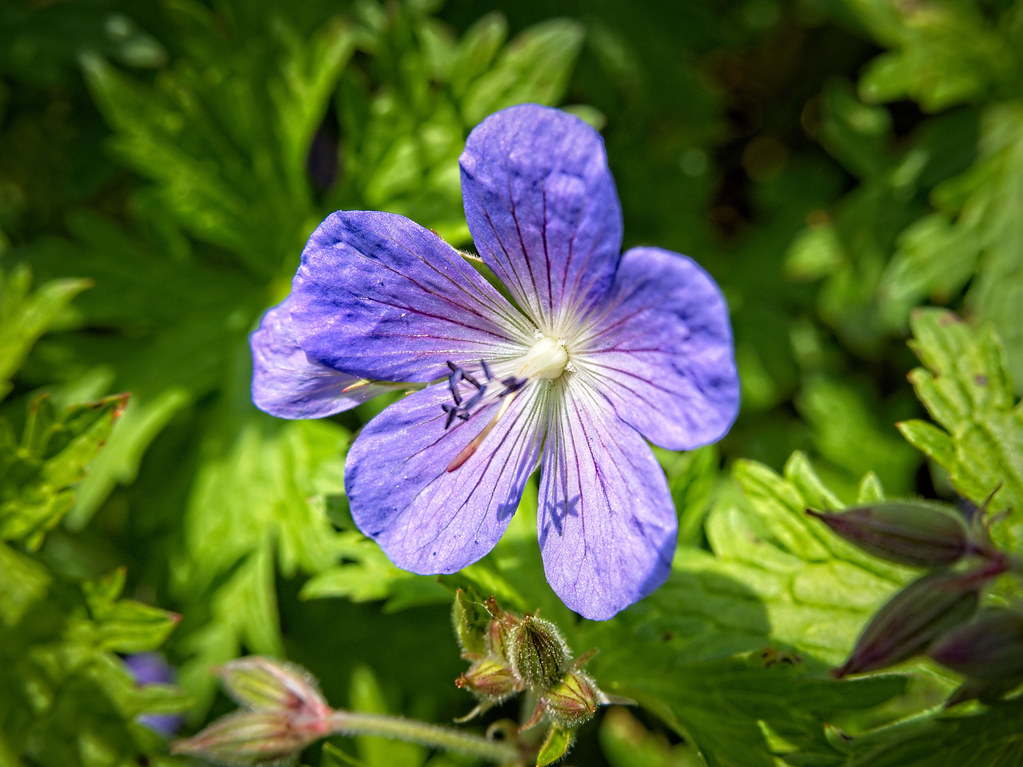
The bed runs twenty feet along the south side of a small white clapboard barn in Calais, Vermont, eight feet wide, planted by Marjorie Eastland in 2017 as an experiment in functional pairing.
Eastland trained as a horticulturist at the University of Vermont and worked for thirty-one years as a field representative for a regional nursery. She retired in 2016 and built the bed the following spring as what she calls a working diagram of companion planting.
What she means by companion planting is narrower than the term as it is often used. She does not mean folk pairings inherited from popular gardening books. She means plant combinations whose interaction can be observed and measured.
The bed contains, at last count, thirty-one species. Each was chosen for a specific functional role.
The first principle is that pest pressure is reduced by visual and chemical complexity. A monoculture of any perennial is a banquet for that perennial's pests. A bed in which every plant has at least three immediate non-related neighbours is, by published research, less easily found by specialist herbivores.
Eastland planted accordingly. She avoided drifts of more than three plants of the same species in adjacent positions. She broke up the bed visually with strong contrasts in foliage form and colour.
The second principle is that beneficial insects need continuous bloom from April through October to maintain breeding populations.
She mapped flowering periods on graph paper before she planted. Her requirement was that at least three species be in bloom in every week of the growing season, with at least one in the Apiaceae family (carrot family) and one in the Asteraceae family (daisy family) at all times.
The Apiaceae and Asteraceae are the two plant families most reliably visited by parasitoid wasps, hoverflies, and lacewings, the principal aerial predators of garden aphids and caterpillars.
Apiaceae representation across the season includes golden alexanders flowering in May, fennel from June to August, dill from July, and angelica in late summer. Asteraceae includes coreopsis, echinacea, helenium, and asters carrying through to October.
The third principle is that nectar accessibility matters. Different beneficial insects have mouthparts of different lengths.
Short-tongued insects, including most of the predatory wasps and hoverflies, cannot access deep tubular flowers. Eastland weighted her Apiaceae and Asteraceae heavily because their flat-topped or composite forms are accessible to almost all beneficial insects.
She included tubular flowers as well, for the bumblebees and long-tongued solitary bees, but did not rely on them.
The fourth principle is olfactory masking.
Several aromatic herbs are positioned among the most pest-susceptible perennials in the bed. Anise hyssop is planted adjacent to phlox, which is prone to powdery mildew and to leaf-mining moths. Catmint is planted around the bases of the roses.
The mechanism, Eastland explains, is not that the herbs repel pests directly. It is that the volatile compounds released by the herb foliage interfere with the chemical cues that specialist pests use to locate their host plants.
Eastland has kept records since 2017. She has not used any insecticide, biological or otherwise, in nine years.
Aphid populations on her roses reach observable levels in late May for perhaps ten days. By the second week of June the ladybird and hoverfly larvae have brought them down to background. She has not lost a rose to aphid pressure.
Japanese beetles, which arrived in the area in 2021, have been present but manageable. She hand-picks for about fifteen minutes per morning during the three-week emergence period in early July and does not consider this a meaningful intrusion on her time.
Powdery mildew on the phlox has been notably reduced compared to a control bed in her front yard planted in pure phlox monoculture. She suspects the airflow improvement from adjacent grasses and the proximity to anise hyssop are both contributing.
What Eastland has not done is achieve a pest-free garden. She emphasises this when she gives talks at the local garden club. The bed has aphids, leaf miners, sawfly larvae, and the occasional cucumber beetle that wanders in from the vegetable plot. What it has, more importantly, is the predators that keep them in equilibrium.
She gives one piece of practical advice. The Apiaceae family is the single most important element for a beneficial-insect strategy in a small border. If a gardener can include nothing else, she should include the carrot family.
Golden alexanders for spring. Fennel for summer. Angelica for late summer. A small bed can hold all three. The wasps and hoverflies will find them.