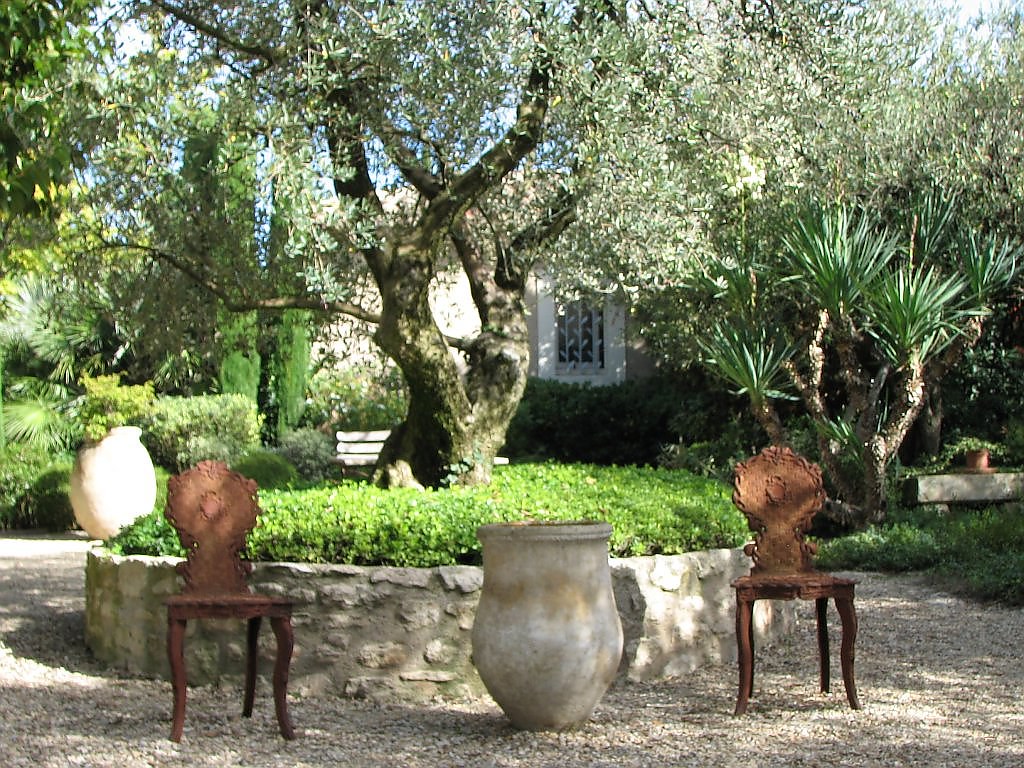
The village of Saint-Polycarpe sits in the Aude department of southern France, fifteen kilometres south of Limoux, on a hill of fractured limestone. Annual rainfall, averaged over the decade 2014 to 2023, is four hundred and twelve millimetres, down from five hundred and sixty-six in the decade ending 2010.
The garden in question is a hectare of former vineyard turned over to ornamental and edible planting by Élodie Marchand and her husband Renaud in 2014. They began with the same expectations they had brought from a garden in Brittany. By 2019 both they and the garden had been reeducated.
What they grow now is a gravel garden in the strict Mediterranean sense, planted into a deep mineral mulch, watered only at establishment, and pruned for structure rather than abundance.
The transformation began with a single failed lavender bed.
Marchand had planted three hundred lavender plants in 2015 in an enriched bed amended with compost. By the summer of 2018, two-thirds had died of root rot in winter wet, the soil holding too much moisture for plants adapted to thin, drained scrub.
She replanted in 2019 directly into the underlying limestone subsoil, covered with eight centimetres of crushed local stone. She added no compost. She added no irrigation.
Survival, three years on, was ninety-four percent.
The principle she had learned, and which the English gravel gardeners Beth Chatto and Olivier Filippi had been writing for years, is that Mediterranean plants do not want a good soil. They want a stable one. They want drainage at the crown, no mulch of organic material, and no summer water once established.
Marchand's gravel garden now covers roughly two thousand square metres on the south-facing slope below the house. It contains, by her last count, two hundred and forty species.
The structural plants are the genus Cistus, the rockroses of the western Mediterranean. She grows seven species, including Cistus albidus, Cistus laurifolius, and a hybrid called Anne Palmer. They flower in May and June in waves of white, pink, and magenta, each bloom lasting a single day.
The middle layer is built on woody herbs. Salvia rosmarinus in three forms, including the prostrate Boule that hangs over a low retaining wall. Lavandula angustifolia and the longer-flowering Lavandula x intermedia. Phlomis fruticosa with its tiered yellow whorls. Santolina chamaecyparissus in clipped balls along a path.
Bulbs carry the winter and the early spring. Marchand has naturalised tulipa clusiana, narcissus tazetta, and three species of allium that flower from March through June. Most are left in the ground year-round.
The summer is the gravel garden's quiet season. Most of the woody plants have finished flowering by July and conserve their resources through August at thirty-eight degrees in the shade.
What flowers in summer is intentional and limited. Eryngium x zabelii, a sea holly with metallic blue bracts. Perovskia atriplicifolia, the Russian sage, in haze of pale lavender. Verbena bonariensis on tall wiry stems. And a single planting of Agapanthus africanus in a sunken pot, which Marchand admits is a Breton indulgence.
Autumn brings the second flush. The Salvia genus produces three more months of bloom. Nerine bowdenii pushes up its pink umbels in October. The Cistus, already dormant, contributes foliage colour through the dry season.
Maintenance is, by northern European standards, almost negligible. Marchand prunes the woody plants once a year in late September, cutting hard to maintain shape and prevent legginess. She top-dresses the gravel every two years with another centimetre of stone.
She does not water from May through October. She does not feed. She does not mulch with anything organic.
The garden has not been without losses. The drought of 2022, which broke records across the Aude, killed two large Cistus and a long-established Phlomis. Marchand replaced them in autumn 2022 from her own cutting-grown stock and considers the loss part of the system.
Visitors from the north often ask if the gravel garden looks austere. Marchand says no. She says it looks honest.
The honesty is in the climate. The garden is a reading of what the place is becoming, not a memorial to what it was.