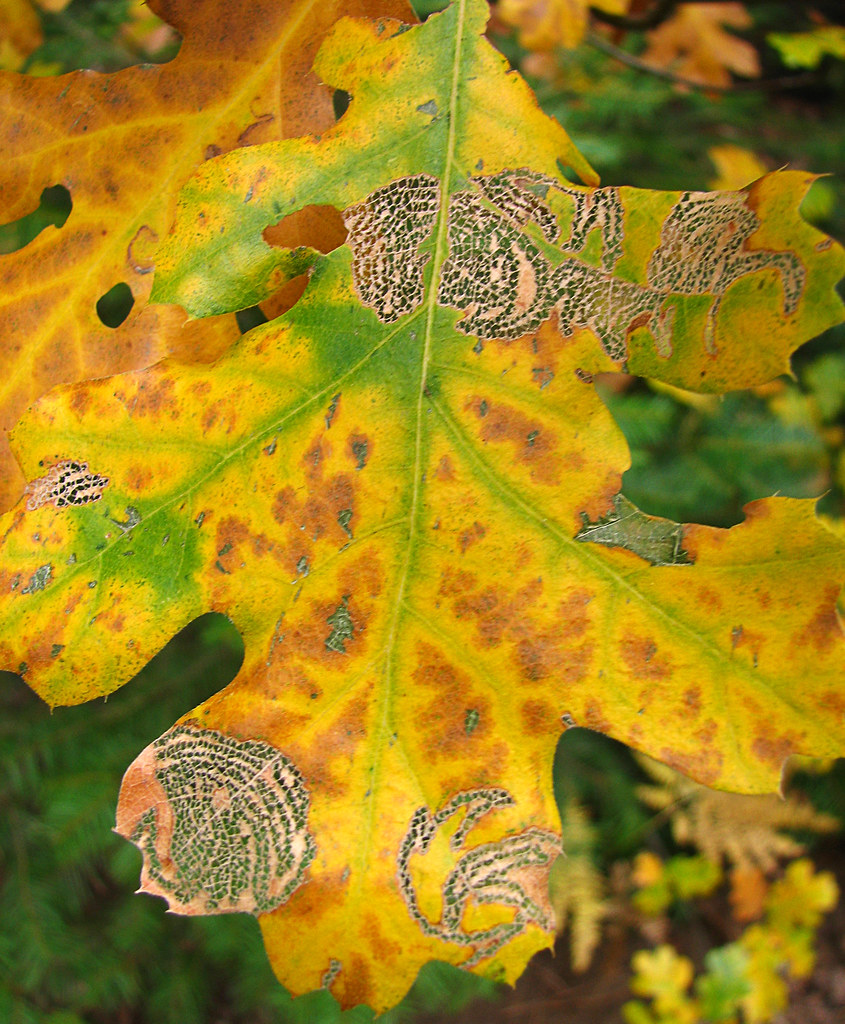
On the morning of July 14th, in a quiet kitchen garden on the south side of Dartmoor, Rowena Bell walked her beds with a hand lens and a small notebook. The exercise took about forty minutes. The notebook entries from that morning, copied below in summary, are a small primer in what bites at what, and how to tell.
The first bed was the runner beans. The damage was a series of regular, clean half-moon notches cut from the leaf margin, each about three millimetres deep, beginning at the leaf edge and working inward in a scalloped pattern.
This is the signature of the adult pea-and-bean weevil, Sitona lineatus. The notches are diagnostic. No other common pest of beans produces this exact, geometric edge-feeding pattern. The damage to the leaves looks alarming and is, in mature plants, almost entirely cosmetic. The weevil larvae, which feed on the root nodules underground, are the part that occasionally matters, and only on very young transplants in cold springs. In July, on established plants, the answer is to do nothing.
Bell noted the damage, did nothing, and moved on.
The second bed was the cabbages. The damage was different in character: ragged, irregular holes in the body of the leaf, ranging from pinhole to about the size of a thumbnail, with no consistent pattern. On the underside of three leaves she found small green caterpillars, about twelve millimetres long, with a faint pale stripe down the back.
These were small white butterfly caterpillars, Pieris rapae, in the second or third instar. The damage pattern is consistent. A single small caterpillar can produce a surprising amount of irregular holing, because it moves frequently between leaves and takes small bites in many places rather than consuming whole sections.
Bell hand-picked the caterpillars she could find, dropped them into a small jar, and walked the bed once more for any she had missed. The walk took eight minutes. She did this every other day through July.
The third bed was kale. The damage on the kale was different again: small, round, peppered holes, mostly less than two millimetres across, distributed across the entire leaf surface without preference for margins or veins. The leaves looked as if someone had fired birdshot at them.
This is the flea beetle, Phyllotreta nemorum on brassicas in southern England, almost certainly. The adult beetle is small, jumps when disturbed, and produces this exact pattern. The damage is cosmetic on mature kale. On seedling brassicas in May it is potentially crop-killing. By July the plants are far past the vulnerable stage and the holes, however unsightly, do not matter.
Bell noted it and did nothing.
The fourth bed was the chard, and here the damage was striking. Long, pale, winding trails inside the leaf itself, sometimes branching, terminating in a wider blister. The damage was inside the leaf tissue, not on its surface.
This is leaf miner damage, the larva of Pegomya hyoscyami, the beet leaf miner, which tunnels between the upper and lower epidermis of the leaf. The damage looks dramatic and reduces the usable leaf area considerably. The response is to remove and bin (not compost) any heavily mined leaves, which physically removes the larvae before they pupate, and to monitor the rest of the plant.
Bell removed seven leaves from three plants and put them in the household waste.
The fifth observation that morning was on a young apple tree at the far end of the plot. The leaves at the growing tips were curled tightly, almost rolled, with a sticky residue and a dusting of pale green insects visible when she opened a rolled leaf with the tip of a pencil.
Aphids on apple. The curling is a giveaway. Most chewing damage opens the leaf. Sap-sucking damage closes it. The aphid's saliva contains compounds that interfere with the leaf's normal growth, and the curling and distortion are the symptom. The sticky residue is honeydew, the aphid's waste.
On a young tree, in July, the colonies are usually managed by the resident predators within ten to fourteen days. Bell checked the underside of the most heavily curled leaf, found four hoverfly larvae and two ladybird larvae already at work, and left the tree alone.
The sixth bed was the lettuce. The damage there was the cleanest of the morning: large, smooth-edged sections missing from the lower leaves, often half a leaf at a time, with silvery slime trails visible in the soil beside the plant.
Slug damage. Unmistakable. The smooth edge of the bite, the size of the missing piece, the slime trail. Bell scattered a thin line of crushed eggshell along the edge of the lettuce row, which does very little but makes her feel better, and resolved to do a slug walk after dark with a torch and a jar.
The notebook, by the end of the walk, had six different organisms identified with confidence from the damage patterns alone. None of the identifications required catching the insect in the act. The bite told the story.
This is the skill that most gardening books skip, because the photographs all show the insect rather than the damage. The damage is more useful. The insect is often nocturnal or quick or hiding on the underside of a leaf. The damage stays put, and it is consistent enough to read.
Bell teaches this to her workshop students by walking them through their own gardens with a hand lens and asking them to describe, in words, what they see. Once the language is precise enough — clean half-moon notch versus ragged hole versus winding trail — the identification follows almost automatically.
The morning's walk in mid-July also produced no action on four of the six beds. This is normal. Most of what the gardener sees is information, not crisis.
The kettle, when Bell finished her walk and came inside, was already warm from earlier.