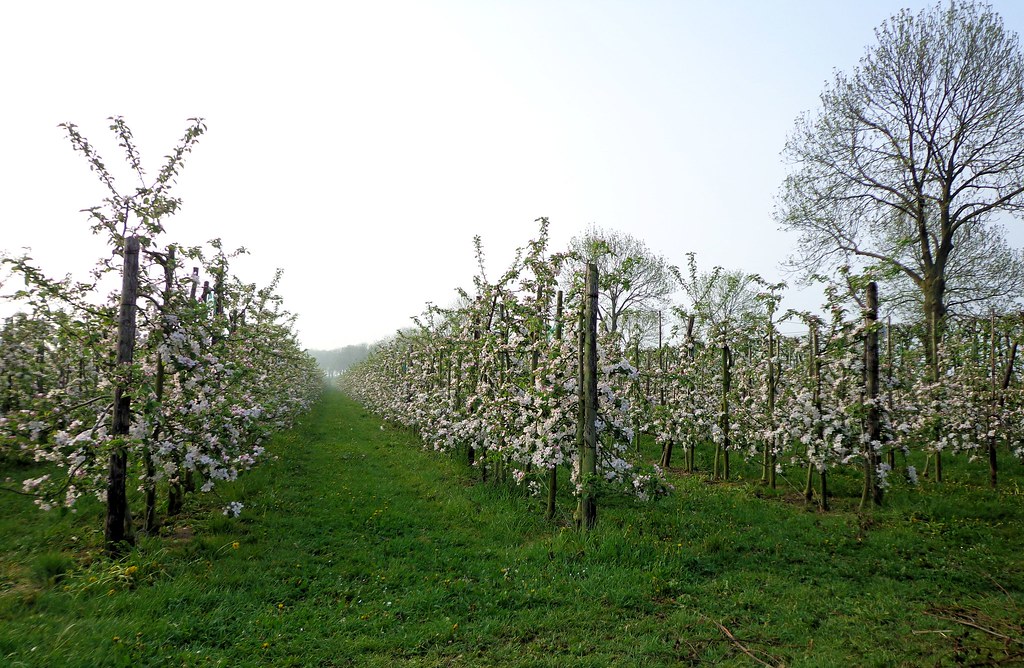
There are three apple trees in the small orchard at the back of Tristan Aoki's property in Fushimi-ku, on the south side of Kyoto. They are a Fuji, a Tsugaru, and a Kogyoku, planted twelve years ago by the previous owner, and they have produced reliable fruit every year since Aoki took over the property in 2019.
For the first four of those years the fruit was, also reliably, wormy. Aoki spent the autumn of 2023 sorting through about sixty kilograms of apples and discarding more than half. Most of the loss was to Cydia pomonella, the codling moth, which is the apple pest that most home orchardists eventually meet.
The codling moth is straightforward in its life cycle and difficult to control without monitoring. The adult female lays eggs on the apple leaf and fruitlet during a relatively short flight period in late spring. The larva tunnels into the fruit, feeds for about three weeks, and emerges to pupate in bark crevices or in the soil at the base of the tree. There are typically two generations a year in temperate climates, occasionally three in warm seasons.
Spraying the trees blindly, on a calendar schedule, is the default home approach. It is also inefficient, often poorly timed, and frequently produces a worse result than no spray at all because it disrupts the resident populations of predators.
The alternative, which Aoki adopted in the spring of 2024, is monitoring. He bought a single delta-style pheromone trap, the kind sold for about five hundred yen at any agricultural supply, and hung it in the central branches of the Fuji tree at the end of April.
The trap consists of a small triangular shelter of waxed cardboard, a sticky paper insert at the bottom, and a rubber pheromone lure that mimics the female codling moth's sex attractant. Male moths flying in the area orient toward the lure, land on the sticky paper, and are caught. The number of males caught per week is a direct proxy for the size of the flying population, and the timing of the catch peaks tells the orchardist when the females are most actively laying eggs.
Aoki checked the trap once a week from late April through September. He recorded the catches in a small notebook he keeps in the shed.
The first male appeared on the trap on May 13th. The catch climbed slowly through the third week of May and peaked on May 27th, when he counted thirty-one males on the sticky paper. The catch declined sharply through the first week of June and was effectively zero by mid-June.
This is the first generation flight, and the most important one to control. The eggs laid during the peak catch hatch about ten days later, which put the vulnerable fruitlet stage in the first week of June. Aoki applied a single spray of spinosad — a biological insecticide derived from a soil bacterium, with a relatively benign profile for non-target species — on June 4th, targeting the fruitlets directly.
He did not spray again until the second generation flight peaked at the end of July, when the trap showed a similar but smaller catch pattern. A second spray went on on July 30th.
Two sprays in the year, both timed precisely to the moth's egg-laying peaks. No calendar spraying. No prophylactic applications.
The apple harvest in October produced about seventy kilograms of fruit across the three trees. Aoki sorted the picking on the kitchen table over the course of three evenings. The wormy fraction, that year, was about eight percent. The previous year, with no monitoring and three calendar sprays, it had been thirty-four percent.
The improvement was substantial and the work was less.
The 2025 season produced a similar result. First-generation peak on May 21st, single spray on June 2nd. Second-generation peak on August 4th, single spray on August 7th. Wormy fraction at harvest: about six percent.
This year, 2026, the trap has been up since April 22nd. The first male was caught on May 9th, slightly earlier than the previous two seasons, which Aoki attributes to a mild April. The peak so far appears to have come on May 24th. He sprayed once, on June 1st, and will watch the trap through July for the second generation.
A single five-hundred-yen trap and a small notebook have, across three seasons now, produced a more effective and considerably less chemical-intensive control of codling moth than the calendar approach he used for his first four years of apple growing. The trap pays for itself in a single season, several times over.
Aoki does not write often about pest management, because his beat is herbs and he has eighty varieties of those to attend to. But the apple trees are at the back of the same garden, and the herbs he grows beneath them — comfrey, lemon balm, oregano — depend in part on a healthy understory predator population that calendar spraying would have made impossible.
The trap also catches, incidentally, a small number of leafroller moths and the occasional unrelated species. He notes them all in the same notebook. The notebook is now in its third year, with a small ribbon marker at the current page, and it lives on the same shelf as his seed records and the small ledger of his herb harvests. The slow accumulation of these records is its own kind of orchard tool.