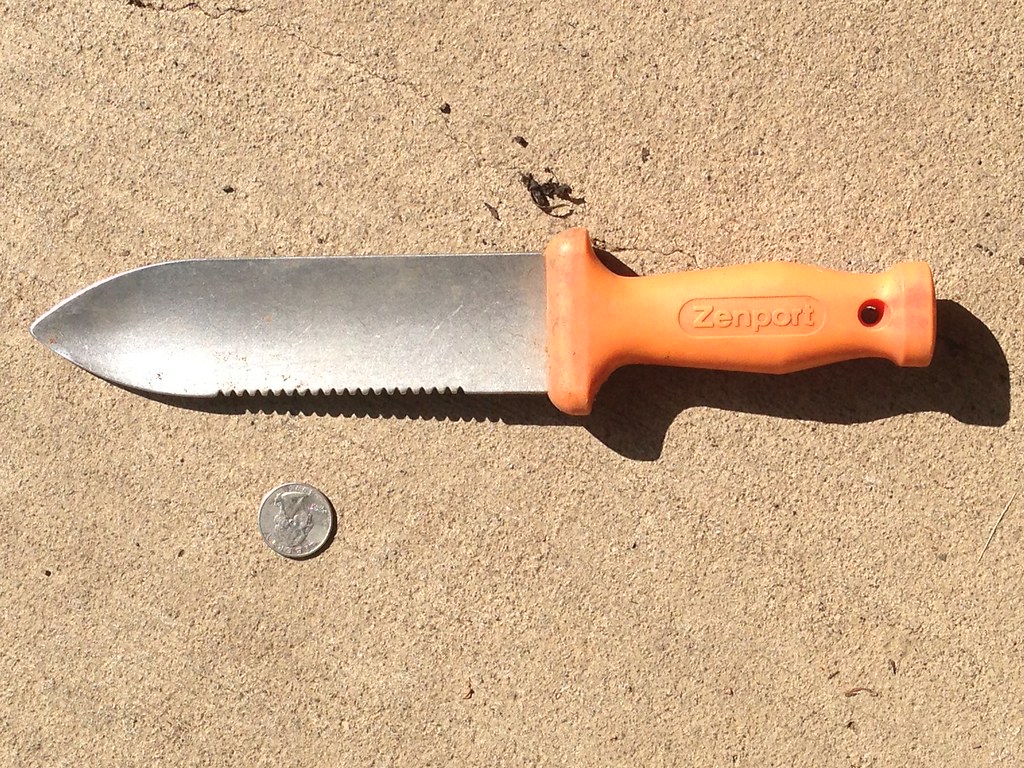
On the third of March, the morning the snowdrops opened along the south wall of her Norfolk garden, Eloise Vinter pulled a Nisaku 650 hori-hori from a leather sheath that had been hanging behind the back door since November. The blade was darker than she remembered, the carbon steel tarnished in honest brown patches, but the edge held when she ran a thumbnail along it.
She had carried the same knife, more or less, since 2017. The current Nisaku was her third. The first she had lost in the leaf bin at the back of a compost heap in October 2019, recovered nine months later by the gardener who took over a plot she was leaving. The second snapped at the tang in the summer of 2023, after she had used it as a lever against a hawthorn root she should have addressed with a mattock.
The hori-hori, she has come to believe, is the closest thing the home garden has to a single, universal hand tool. It is a trowel, a weeder, a transplanting knife, a small saw on its serrated edge, a measuring stick along the inch markings stamped into the blade. It is also, she would say if pressed, a kind of habit — a small weight at the hip that organises the way one moves through a bed.
The knife is Japanese by origin and agricultural by intent. Hori means dig; the doubling is intensifying rather than informative. The traditional version, made for foragers of mountain vegetables in the Nagano hills, was a heavier, single-edged tool with a wooden handle and a leather sheath, carried into bamboo thickets after sansai in the early spring.
Its western form, sold under perhaps two dozen brand names now, has migrated steadily into the gardener's belt over the last fifteen years. Vinter remembers seeing the first one for sale in a stand at the Hampton Court flower show in 2011. The young salesman, an apprentice from a tool importer in Bristol, had to explain what it was three times before the visitor before her bought one.
The Nisaku 650 she carries weighs 230 grams. The blade is 18 centimetres of stamped 420 stainless on the cheaper models and forged tamahagane-derivative carbon on the model she prefers. The handle is plain Magnolia obovata, oiled once a year with raw linseed and otherwise left to age.
What surprised her, in the first season she carried one, was how many other tools quietly stopped earning their place at the hip. The narrow trowel that came in a set from her mother in 1998 went into the shed drawer in May and did not come out until October. The asparagus knife she had bought at a market in Bury St Edmunds went the same way. The transplanting fork, the dandelion weeder, the small pruning saw she had once thought essential — all relegated.
The hori-hori dug planting holes for 200 onion sets that April. It pried the long taproots of dock from the gravel path along the herb bed, working in under the crown the way a dental probe lifts a tooth. It cut twine on a roll of jute. It scored the rootball of a pot-bound nepeta before she dropped it into a hole the same knife had just dug.
There are limits. Vinter is careful to name them, because she finds tool writing too often tips into evangelism. The hori-hori is not a substitute for a long-handled spade in any digging job larger than a single bulb. It is not a substitute for proper secateurs on anything thicker than a finger of new growth. It will not, despite the claims of more than one online catalogue, replace a hand fork in a bed where the soil is compacted clay and the roots of perennial weeds run sideways under the surface.
She has also seen a hori-hori used as a screwdriver, a tent peg, and once, memorably, as a cheese knife at a long lunch in a gardening club tent at the East of England show. The cheese knife was a mistake. The blade picked up a faint reek of Stilton that no amount of scrubbing with bicarbonate removed for the rest of the season.
Care is simple and easy to neglect. After every use Vinter wipes the blade on the leg of her trousers, which is why her gardening trousers carry a long brown smear from knee to hip by August. Once a week, on a Sunday evening if she remembers, she runs the blade through a folded scrap of oilcloth she keeps in a tin by the back door. The cloth is rubbed with a 50-50 mixture of beeswax and jojoba, melted in a small pan on the stove in February and decanted into a flat tin that lives in the boot rack.
The serrated edge is sharpened with a small diamond file, four or five passes per tooth, twice a year. The straight edge is sharpened on a 1000-grit Japanese waterstone, soaked in a jam jar for ten minutes first. She learned the stroke from a sushi chef at a restaurant in Norwich who had been talked into giving an evening class. The chef had laughed, kindly, at her first attempts and then guided her wrist with two fingers until the angle held.
The sheath matters more than the buyer usually thinks at the time of purchase. A good leather sheath, oiled twice a season, sits flat against the hip and does not flap. A nylon sheath, which is what most knives ship with, will catch on the lip of a wheelbarrow and pop the knife into the compost heap before the gardener notices it has gone.
Vinter's current sheath was made by a saddler in Wymondham named Iain Pelham, who took her measurements one wet afternoon in January 2022 and posted the finished sheath in March, with an apology for the delay. It cost forty-two pounds. It will, she expects, outlast the knife.
There is a small body of writing on the hori-hori in English now — none of it definitive, most of it on gardening blogs of varying quality. The best practical account she has read is a 2019 piece by a Vermont seed-saver named Hadley Chen, who carried one for a full season at a 35-acre market garden and recorded its tasks in a small notebook. Chen's tally for the season ran to 47 distinct uses, of which 38 he counted as the knife outperforming the alternative.
Vinter has not kept a tally. She suspects that if she did, the count would dilute the case rather than make it. The knife is good because she does not think about it. It is in the sheath; the sheath is on the belt; the belt is on her in any garden trouser she owns. The decision to reach for it is not a decision.
What she would say, if she were forced to name a single argument for the tool, is that it teaches the wrist. A hori-hori demands a different angle from a trowel — closer to vertical, the elbow tucked, the weight of the body pressed straight down the line of the forearm. After a season of using it the gardener finds she is digging less and prying more, and her shoulders thank her for the difference in February.
She does not think a hori-hori is a magic object. She thinks it is a well-designed object that suits the way a small garden actually gets worked. There is a difference. The first claim leads to evangelism, the catalogues, the online videos, the small drawer in the kitchen filling up with branded versions of every tool a celebrity gardener has been seen holding.
The second claim leads to a single knife on a single sheath, kept oiled, sharpened in February and August, and carried until the leaves come off the witch hazel in November.
On the third of December last year Vinter took the Nisaku off her belt for the season, ran it once more through the oilcloth, slid it into the sheath, and hung the sheath behind the back door. The knife had cut twine, dug 312 planting holes, lifted four cubic feet of dock, scored eleven rootballs, divided one large clump of bearded iris, and on one notable September afternoon, opened a bag of cement.
She does not recommend opening cement bags with it. But it did the job.