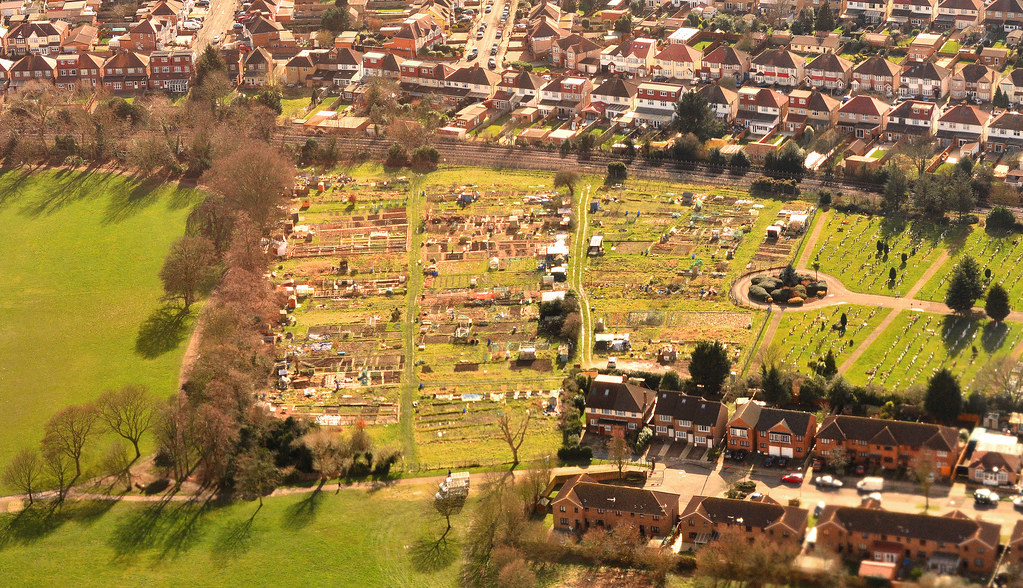
The South Grove Allotment Society sits on three and a half acres between a railway line and a row of Edwardian terraces in Walthamstow, east London. It contains seventy-two plots. The waiting list, in early 2026, stands at one hundred and ninety-four names.
Plot 47A is at the back of the site, against the railway embankment. It measures ten poles, which is the old English unit by which allotments are still measured and which equates to roughly two hundred and fifty square metres.
It has been worked by the same family since 1973, when a retired Jamaican postal worker named Cyril Beckford took on the plot at the age of sixty-one. He had emigrated to London in 1956 and had grown vegetables behind his Stoke Newington house for fifteen years before he qualified for the allotment.
Cyril Beckford died in 1992, at eighty. The plot passed to his daughter Cassie Beckford, then a London Underground driver in her thirties. Cassie worked the plot for twenty-six years and retired from the railway in 2018.
In 2020 the plot passed, by quiet family arrangement and a formal transfer of tenancy through the society, to Cassie's daughter Imani Beckford, who is now thirty-seven and works as a paediatric nurse at the Whittington Hospital.
Imani arrives at the plot at six on a Wednesday morning in early June, before her shift. The plot in early June is in the awkward middle phase: the spring crops are mostly out, the summer crops are mostly not yet in.
She is harvesting the last of the broad beans, which her grandfather first planted in this soil in October 1973 and which her mother continued, and which she now grows from seed she saves each year from her own crop. The bean is a tall white-seeded type that the family calls Cyril's Bean, though it is almost certainly a descendant of an Aquadulce Claudia.
The bed in which the beans are growing is the same bed in which they have grown, in a four-year rotation, since at least 1985, when Cassie Beckford laid out the plot on a more systematic rotation than her father had used.
Cyril's method had been less formal: he grew what he wanted where there was space, and where he could not remember what had been the year before, he planted potatoes. The plot still benefits from this approach. The soil is deep, friable, and rich in organic matter from fifty-three years of household composting and the occasional load of horse manure from the City of London Police stables.
Imani composts everything. The compost heap, in a corner of the plot, is in three bins built from pallets, each about a cubic metre. She turns them once a year, in November, with a long-handled fork that was her grandfather's and which she has had re-handled twice.
The morning's harvest is two ice-cream tubs of broad beans, a small bunch of mint, and a handful of the season's first courgettes. She takes them home in a cotton tote bag.
The plot's herb section, which her mother laid out in 1996, contains thyme, sage, rosemary, the mint just mentioned, a tall fennel that self-seeds along the path, a small bay tree in a pot, and two clumps of chives that Cassie remembers her father bringing from a friend's allotment in Hackney in 1981.
Imani points out the chives with particular affection. They are, by her count, the longest continuously cultivated plant on the plot.
She also grows scotch bonnet peppers under a small polytunnel that her mother built in 2009 from secondhand polythene and recycled scaffolding bar. The peppers are essential to the family's cooking and to the cooking of three other plot-holders who barter with her for them.
The barter economy of the allotment is, Imani says, the most underrated part of the system. She trades scotch bonnets for the early sweet potatoes that an Indian family on plot 12B grow under polythene each spring. She trades courgettes in August for the saffron-tinted rice that a plot-holder named Aboud Ghattas grows on a small patch and processes himself.
The plot-holders' demographic at South Grove is roughly half white British, a quarter of Afro-Caribbean and African origin, and the remainder a mix of South Asian, Eastern European, and a small but persistent Polish contingent who grow the best dill on the site.
The Society itself has been on the land since 1894. The committee meets monthly in a small wooden hut near the gate. Imani is the secretary. Her mother served as treasurer for twelve years and her grandfather, in the early 1980s, served briefly as chair until, in his own account, the meetings became too long.
What Imani values most about the plot, beyond the food, is the continuity. She has photographs of her grandfather standing by the broad bean canes in 1981. She has photographs of her mother in the same spot in 1998. She does not, she admits, have many of herself, because she is usually the one taking the pictures.
Her son, who is seven, comes most Saturdays. He has his own small bed at the front of the plot, which last year produced a single very large pumpkin and a row of carrots that he ate raw on the spot.
Whether the plot will pass to him in time is, Imani says, his decision to make. She would not force it. She would, however, prefer it.
The morning shift at the Whittington begins at eight. She locks the plot gate at twenty past seven and cycles the mile and a half to the hospital. The broad beans go into a bowl in her kitchen. She will shell them in the evening, after her son has gone to bed.
Cyril Beckford's beans, in their fifty-third generation on the plot, are tonight's dinner.