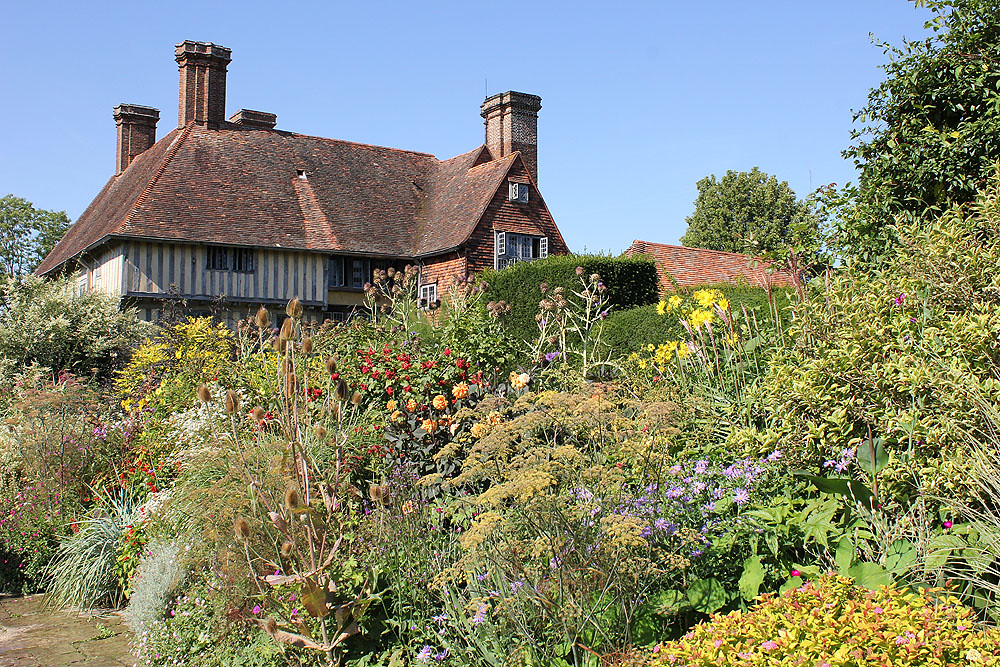
Tristan Aoki arrived at Great Dixter on the second of April 2025 with a small canvas duffel, a pair of Wellingtons two sizes too large, and a residency place arranged through the garden's apprentice programme. He left on the second of April 2026.
The arrangement is informal. The garden takes on a handful of unpaid placements each year, in addition to its salaried apprentices, on the understanding that the placement will work the same hours as the rest of the team, attend the morning briefing, and leave any opinions about Christopher Lloyd's planting at the gate.
Aoki had read Lloyd's books since his twenties. He had also, on a previous visit in 2018, watched the head gardener Fergus Garrett deadhead a stand of Verbena bonariensis for forty minutes and thought, with some clarity, that this was a discipline he wanted to learn.
April was wet. The peacocks, of which Dixter keeps three, picked their way across the topiary lawn with what Aoki's notebook describes as visible objection. The exotic garden, which had been cut back to bare soil in March, was still bare soil in mid-April.
The first task assigned to him was the dividing of a clump of Hemerocallis in the high garden. The clump was perhaps eighteen years old. It came up in four sections, two of which were composted on the spot because the rhizomes had become woody and inert. The other two were replanted with a handful of bone meal and a saucer of water.
Garrett, who is in his early sixties and walks with the slight forward lean of a man who has spent decades over a border, watched the operation from twelve feet away and said one word: shallower. Aoki re-planted the divisions an inch higher.
By May the long border was beginning. Dixter's long border, which Lloyd inherited from his mother Daisy and re-conceived from 1954 onward, is two hundred feet of mixed planting that runs along the south side of the meadow. It is not a herbaceous border in the traditional sense. It includes shrubs, climbers, biennials, and the half-hardy annuals that Lloyd loved and Garrett has continued.
Aoki's job that May was the staking. Dixter does not use proprietary plant supports. The staking is done with hazel and birch from the estate, woven by hand each spring into a kind of low cradle that supports the plants from beneath without showing.
He stakes one bed in three hours. Garrett re-does it in forty minutes, with the same materials, and the result is invisible by July. Aoki writes in his notebook that evening: The difference is twenty-six years of practice and the willingness to break twigs that are nearly right.
June at Dixter is when the meadow flowers. The meadow is the part of the garden most visitors do not understand. It is mown twice a year and seeded with no improving mixture. What it produces is what was already in the soil when Lloyd's mother took the lawn out of management in the 1920s.
In late June 2025 the meadow held common spotted orchid, yellow rattle, ox-eye daisy, and a single colony of green-winged orchid that the staff treat as a kind of household pet. The colony is counted each year. In 2025 it numbered eighty-two flowering spikes, up from sixty-three in 2024 and forty-one in 2018.
July and August are the long-border months. The dahlias, which Lloyd reintroduced in defiance of the prevailing taste of the 1990s, were at full height. Dahlia Hillcrest Royal in deep purple. Dahlia David Howard with its orange flowers above bronze foliage. Dahlia Witteman's Superba in screaming red.
Aoki's notebook entry for the eleventh of August reads: Visitor asked me whether the colours were intentional. I said yes. She said she would have used softer tones. I did not answer.
September was succession. Dixter's planting depends on a constant in-and-out of material as the season progresses. The half-hardy annuals raised in the cold frames in spring are dropped into gaps left by the early perennials. The asters are coming on. The salvias are at their second peak.
It is in September that Aoki was given responsibility for a single ten-foot stretch of the long border, with the instruction to plan its November and December as well as its remaining autumn. He spent four evenings drawing in pencil before he made a decision.
What he chose, in the end, was a backdrop of Salvia Amistad held over from August, an under-planting of Salvia involucrata to take it into October, and a foreground of Tulipa Spring Green planted in late October for the following April. Garrett approved with a nod. The tulips bloomed on the eighteenth of April 2026, two weeks after Aoki had gone.
October was leaf-fall and the meadow's second cut. November was the dismantling of the exotic garden, the canna lifted and stored in the potting shed under dry sand, the dahlias dug and labelled in pencil on small wooden tags.
December was quiet. The garden closes to the public in late October and reopens in late March. The staff work shorter days, repair the hazel hurdles, edit the seed orders.
It was in December that Aoki learned to take seed. The salad burnet, Sanguisorba minor, had been growing in a strip near the orchard for as long as anyone could remember. Aoki was sent to collect seed in the second week of December, before the rain washed it from the heads. He collected two ounces, which is a great deal of salad burnet.
Garrett, when he saw the harvest, told Aoki that the salad burnet at Dixter had been collected from the same parent plant for at least forty years, and possibly longer. Aoki took an envelope of it home with him in April.
What he learned across the year, he writes in the notebook's final entry, is not a technique but an attention. The garden teaches you to see where things want to be. The rest is hazel rods and a willingness to redo your work.
Aoki has been growing salad burnet in his Kyoto courtyard since May. The first seedlings came up exactly as the Dixter ones do. The second leaves were slightly smaller, which he attributes to the heavier soil.