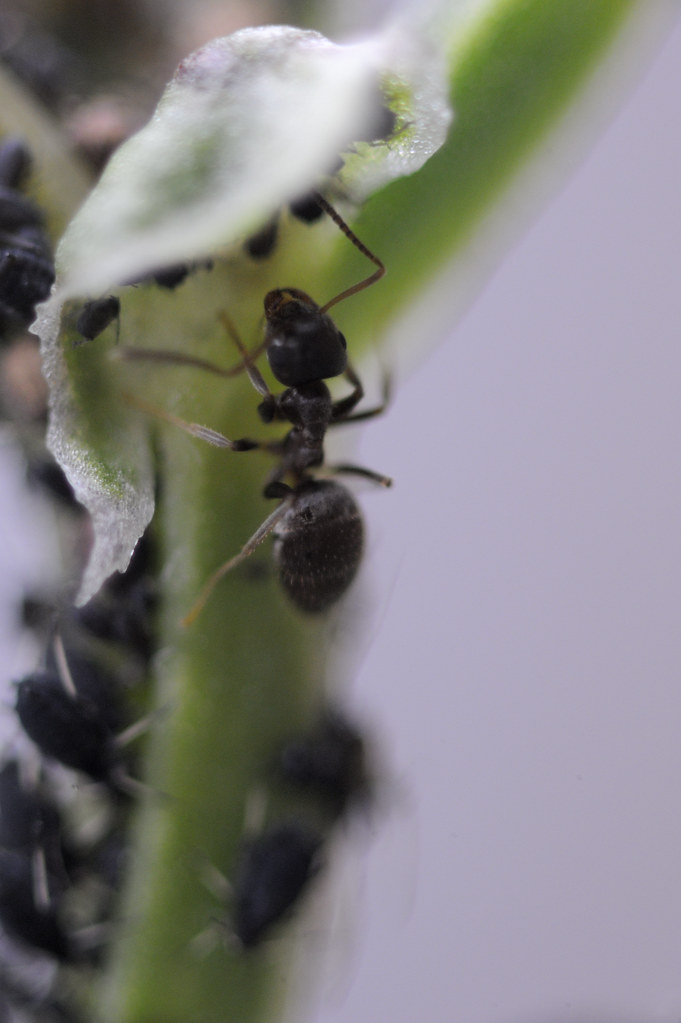
The first colony arrived on the broad beans at the end of October, which in Lower Hutt is late spring. Octavia Bryne counted seventeen aphids on a single growing tip on a Tuesday morning and decided, as she has decided every spring for the last nine years, to do nothing for a week.
This is the part of integrated pest management that gardeners find hardest. The aphid is visible. The damage is implied. The instinct is to act.
Bryne keeps a 14-by-20 foot kitchen garden on a clay slope above the Hutt River. She has been an entomologist for two decades, fourteen of those years on commercial apple orchards in the Hawke's Bay, and the remainder writing about the same problems at a smaller scale. The aphids on her broad beans are Aphis fabae, the black bean aphid, and she has watched them every spring since she put the bed in.
The doing-nothing week is not passivity. It is data collection.
By the following Tuesday the colony on that single tip had grown to about a hundred and twenty. Three tips on two other plants had similar starts. But Bryne had also counted six seven-spot ladybird larvae on the lower leaves, and one adult hoverfly making slow figure-eights over the bed in the late afternoon. The garden, in other words, had noticed.
This is what integrated management actually means: noticing what is already there before adding anything new.
She pinched out the worst-affected growing tip on the largest plant and dropped it into a jar of soapy water. The pinch served two purposes. It removed about a third of the visible aphid population in a single motion, and it interrupted the apical growth, which slows the production of the tender new tissue the aphids prefer. The bean plant would put out side shoots within ten days. Those shoots would be sturdier, and less attractive.
The soapy-water jar is not a kill jar so much as a quarantine. Bryne leaves it on the back step for forty-eight hours and then tips the contents into the compost heap. The ladybird larvae she finds in the jar by accident she returns to the bed.
For the next ten days she watered the beans in the morning rather than the evening. Aphids prefer plants under mild water stress. A morning watering, before the day's heat, keeps the cells turgid and the sap less concentrated. It is not a cure. It is a small adjustment, the kind that adds up across a season.
By the third week of November the ladybird population on the bed had reached what Bryne calls working strength. She counted forty-one larvae on a single morning walk-through, mostly on the underside of the lower leaves. The aphid colonies on the upper tips were holding steady, neither expanding nor collapsing. This is the equilibrium that integrated management aims for. Not zero aphids. A tolerable number of aphids, held there by their natural predators.
She does not spray. She has not sprayed her own beds, with anything, for nineteen years. The orchards she worked on used selective insecticides on a calendar schedule for the first part of her career and on a threshold-and-monitoring basis for the second. She watched the second method outperform the first by every meaningful measure, including yield. It also produced, by year five, an orchard floor full of native carabid beetles and a complete year-round predator complex she could rely on.
A kitchen garden is not an orchard, but the principle scales down well.
What she does, when the predator population is slow to arrive, is plant for them. The bed contains a strip of phacelia at one end and a small patch of dill at the other. Both produce the small, accessible flowers that hoverflies in particular need for the nectar that sustains the adult stage. The larvae of those hoverflies are the most efficient aphid predators in her garden, by a considerable margin.
She also leaves a small patch of stinging nettle in the corner behind the compost heap. Nettles host their own aphid species, Microlophium carnosum, which does not move to other plants but does support a thriving local population of ladybirds and lacewings through the early spring. By the time the bean aphids appear, the predator population is already established and looking for new hunting grounds.
The nettles also sting, which is the price.
By mid-December the broad beans were producing their first pods. The aphid colonies had collapsed to scattered individuals, which is the predictable arc of an unmanaged but observed population. Bryne harvested the first beans on the sixteenth, weighed them at 340 grams, and noted the date in the small ledger she keeps in the shed.
The bed has produced broad beans in every one of the last nine years. The aphids have appeared in every one of those nine years. The yield, year over year, has not declined.
This is the boring conclusion that the IPM literature keeps arriving at, and that most gardeners keep needing to learn the hard way. The aphids are not the problem. The absence of the things that eat the aphids is the problem. Build the second condition, and the first stops being a crisis.
Bryne pulled the last of the broad bean plants at the end of January and cut them into the compost heap. The roots she left in the ground, partly for the nitrogen and partly because the soil structure was better when she didn't disturb it. The bed will go to courgettes next, and the courgettes will have their own visitors.
None of this is dramatic. Most useful gardening isn't.